
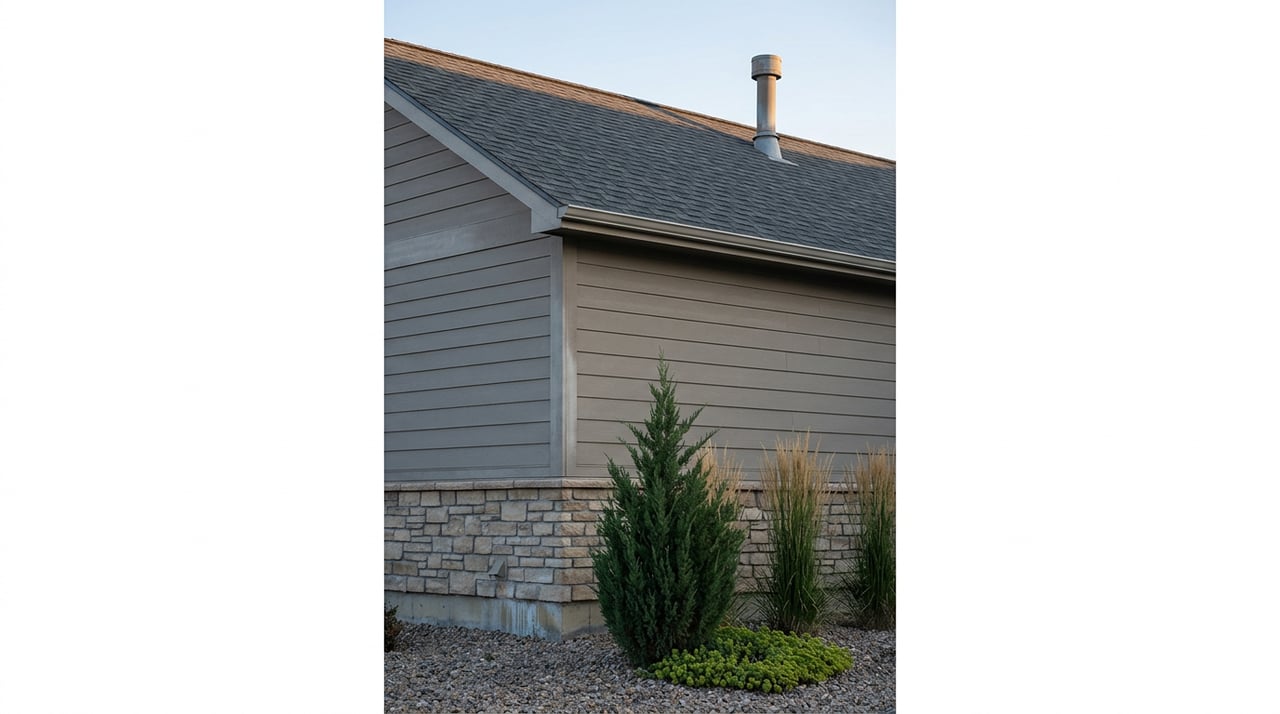
Every new single family home built in the Town of Erie today has to include a radon system as a condition of construction. That's not a builder upgrade or a marketing extra. It's required by Erie's building code, which points directly to Appendix F of the International Residential Code, the section that governs radon control methods. The system is real. It's inspected. It's also, by the plain language of the agencies that require it, designed to solve only part of the problem.
That gap is the part almost nobody explains to a buyer standing in a new-build kitchen in Colliers Hill, Westerly, or Flatiron Meadows. The vent pipe running from the foundation to the roofline looks finished. It isn't. And the same week you're admiring it, Colorado law is quietly asking a very different question about the resale house three streets over.
What the code actually requires, and what it doesn't
The system built into new Erie homes is what building departments call "passive" radon-resistant construction. There's no fan. It works by giving soil gas somewhere to go before it reaches your living space: a layer of gravel or gas-permeable material under the slab, plastic sheeting over that layer, sealed foundation penetrations, and a vent pipe running the gas up and out above the roof. Boulder County's own description of radon-resistant construction is direct about what this buys you: these passive systems, properly installed, lower indoor radon levels by about 50 percent.
Fifty percent sounds like a solved problem until you run the math on an actual house. A home with a radon level of 10.0 pCi/L, roughly typical for a home that would have tested high in this region before mitigation, comes down to 5.0 pCi/L with a working passive system. That's still above the EPA's action level of 4.0 pCi/L. The code requirement built the plumbing. It didn't promise the number.
That's why the Town's own guidance tells new owners to test as soon as possible after move-in, not to assume the pipe means the job is done. If the post-occupancy test comes back at or above 4.0 pCi/L, the fix is usually straightforward: an electrician-accessible junction box is already built into the system for exactly this reason, so a licensed radon professional adds a fan and retests to confirm the number actually drops below the threshold.
Passive vs. active, side by side
| Passive system (code minimum) | Active system (fan added) | |
|---|---|---|
| What it is | Gravel layer, sealed foundation, vent pipe, no fan | Same components plus a radon fan installed on the vent pipe |
| Typical reduction | About 50 percent | Can bring most homes well below 4.0 pCi/L |
| When it's installed | Automatically, during new construction in Erie | Retrofit, if the post-move-in test comes back elevated |
| Who installs the retrofit | N/A | A Colorado-licensed radon mitigation professional |
| Confirmation step | Buyer tests after move-in | Retest after fan install to confirm result |
The retrofit itself isn't exotic. The junction box in the wall is there precisely so a fan can be added without opening up finished space. But it is a step, a cost, and a schedule that only shows up if someone actually runs the first test. Skip that test because the house is new, and the fan-or-no-fan question just gets deferred to whoever tests the house next, which under Colorado law now has to be disclosed.
The paperwork problem on the resale side
New construction gets a code requirement. Resale gets a disclosure law, and it's a different mechanism doing a similar job. Colorado's SB23-206, in effect since August 2023, requires every residential sales contract in the state to carry a specific, bold-faced warning, and requires sellers to hand over what they actually know. The text the Colorado Division of Real Estate has confirmed for broker contracts reads, in part:
The Colorado Department of Public Health and Environment strongly recommends that all home buyers have an indoor radon test performed before purchasing residential real property and recommends having the radon levels mitigated if elevated radon concentrations are found.
Beyond the warning language, the law requires the contract or seller's property disclosure to state whether a radon test has ever been performed on the property, what the most recent results and records show, what mitigation or remediation has been done, and whether a mitigation system is installed at all. If a seller has that information and doesn't produce it, the statute itself gives the buyer a claim for damages plus court costs. This isn't a courtesy disclosure. It's a paper trail with teeth, and it applies whether the house is a two-year-old build in Westerly or a decades-old resale near downtown Erie.
Why this matters more here than the national radon map suggests
Every county in the Denver metro area, including the Boulder County portion of Erie, sits in the EPA's Zone 1 classification, the agency's highest predicted-indoor-radon category. That map is a planning tool, not a home-by-home verdict, and radon officials are consistent that it should never substitute for an actual test. But the county-level data behind that classification is worth sitting with. In the largest available dataset of pre-mitigation radon tests across Boulder County, covering results from 2005 through 2025, 43.5 percent of nearly 20,000 tests came back at or above the 4.0 pCi/L action level. That's not a rare outcome in this part of the Front Range. It's close to a coin flip.
None of that tells you what a specific address in Colliers Hill or Flatiron Meadows will test at. Two houses on the same block can read very differently depending on what's under the slab, not what's on the countertops. That's exactly why the test matters more than the map, and why "the house is new, so it's fine" is the one assumption the data doesn't support.
What to actually do with this, on either side of the transaction
If you're buying new construction in Erie:
- Ask whether the passive system was installed to Appendix F and get the permit record, not just a verbal confirmation.
- Schedule a radon test as soon as you're moved in. This is the Town's own recommendation, not an optional extra.
- If the result comes in at or above 4.0 pCi/L, get a quote from a licensed Colorado radon professional to add a fan through the existing junction box, then retest to confirm.
If you're selling a resale home:
- Pull together any test results, mitigation records, or system documentation you have. The disclosure law requires you to produce what you know, not to commission new testing you don't have.
- Make sure your listing agent has built the required bold-faced disclosure into the contract itself, not left it as an afterthought.
- If you've never tested, say so. An honest "no test on file" is a defensible disclosure. A skipped disclosure is a liability.
FAQ
If my new Erie home already has the vent pipe, do I still need to test? Yes. The Town's own guidance says to test as soon as possible after move-in specifically because the passive system's performance depends on your home's soil and foundation, not just the fact that the pipe was installed correctly.
What does it cost to add a fan if the passive system isn't enough? Retrofitting an existing passive system with a fan is generally a fraction of what a full mitigation install would cost in a home with no system at all, since the gravel layer, sealed penetrations, and vent pipe are already in place. Get quotes from a licensed Colorado radon professional for your specific foundation type.
Does a seller have to tell me about a radon test from years ago that showed a high result? Yes, if they have knowledge of it. SB23-206 requires disclosure of known test results and any mitigation performed, as part of the sales contract or property disclosure, regardless of how old the test is.
Whether you're weighing a new build with a pipe already in the wall or a resale with paperwork to review, the number that matters isn't on the code inspection sticker or the listing sheet. It's on a test you schedule yourself. If you want help reading that number in context, or you're planning a sale and want to get the disclosure right the first time, Peak Home Partners can walk you through what to test, what to ask for, and what to expect at closing.


